Current Projects

My work explores the role of history and the humanities in a changing world—from their value in professional life, leadership, and decision-making to the ways artificial intelligence is transforming how we produce, organize, and use knowledge. I'm particularly interested in how historical thinking can help people navigate careers and tackle challenges beyond academia, and how new technologies can expand what historians and other humanists are able to accomplish. Alongside these interests, my historical research focuses on modern international history, especially Eastern Europe, the Cold War, and the movement of people, ideas, and cultures across borders.

Image by
Mind / Machine / Market: The Humanities in the Age of AI
Co-edited with Michael Weatherburn and forthcoming from Texas A&M University Press in 2028, this volume of collected essays explores the evolving relationship between the humanities and artificial intelligence. It starts from the premise that as AI becomes increasingly influential, the insights, methods, and concepts of the humanities are more valuable than ever—even as these technologies are transforming humanistic scholarship and practice, for better and for worse. Marking the 60th anniversary of the Walter Prescott Webb Lectures, the volume is the first in the series to bring together contributors from multiple disciplines, including history, philosophy, anthropology, and the arts. It explores how AI creates new opportunities—and perhaps even a necessity—for collaboration across disciplinary boundaries that have traditionally been difficult to cross. The volume also brings academic scholars into conversation with practitioners from the technology and business sectors, bridging the worlds of thinking and doing. Together, these perspectives offer fresh insights into how the humanities can help shape the future of AI, and how AI might reshape the humanities in turn.

Lisa Larsen: A Biography of a Cosmopolitan Photojournalist
This ongoing biography explores the life and career of Lisa Larsen (1922–1959), a German-born American photojournalist whose work for Life magazine captured some of the defining people and events of the 1950s. Following her travels across the United States, Europe, and Asia, the project examines how Larsen's photography and personal observations challenged conventional understandings of the Cold War and the societies on both sides of the Iron Curtain. It also explores her remarkable career as a woman in photojournalism and the distinctive human perspective she brought to her work.
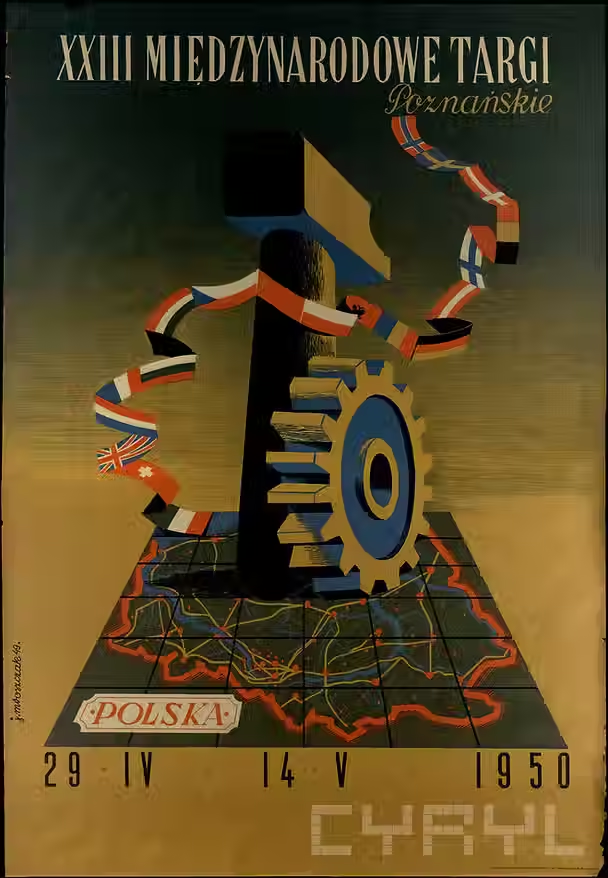
"Reinventing Poland: The Poznań International Fair, National Identity and the Twentieth-Century Rebellion of the East European Peripheries"
I am currently writing a book that examines Poland's history through the lens of the Poznań International Trade Fair. Located in the western Polish city of Poznań (before 1918: Prussian Posen), this unique institution served interchangeably as a showcase of German imperial prowess, a business card of the independent Polish state, and a poster child of socialist planned economy. During the time of Cold War-era isolation, the fair linked Poland to various economic, political and cultural developments around the world. Poland's modern identity, cultivated largely in Warsaw, rested on the Romantic myth of armed struggle and sacrifice. Triangulating regional, national and international histories, I argue that the fair enabled many Poles to contest that idea, and to promote a more pragmatic, business-like identity, rooted in such local values as industriousness, efficiency and hard work. Partly supported by Germany's Alexander von Humboldt Foundation, he project is based on archival research in Poland, Germany, Russia, France, the United Kingdom and the United States.
selected academic Publications

"Westerners, Western Power and Polish Society in the Mid-Twentieth Century: The Poznań International Trade Fair as a Complex Frontier"
November 1, 2024
Drawing on Polish, US, French, British and German archival documents, I examine the encounters between Western and Polish participants at the International Trade Fair in the Polish city of Poznań in the 1950s and 1960s. Challenging the predominant Cold War framework, I show that Westerners who came to Poznań drew on power and privilege while pursuing personal interests. These encounters are best seen in the context of a relationship between Westerners and East Europeans that spans decades, and even centuries, and that involved encounters fraught with contestation over economic power and cultural dominance.

"Searching for the Soviet Woman: Photojournalist Lisa Larsen in the Soviet Union, Spring-Fall 1956"
December 5, 2022
This photo essay examines photojournalist Lisa Larsen's experiences in the Soviet Union in the period from spring through fall of 1956. It concentrates on her written and visual explorations of what it meant to be a woman in the USSR against the backdrop of her long standing interests in the roles of women in society worldwide during her work for Life magazine. I show that Larsen's visual and written storytelling goes far beyond the commonplaces of midcentury America. I suggest that it is helpful to understand her 1956 visit to the Soviet Union in the broader context of her biography. The article also aims to highlight more of Lisa Larsen’s photography, much of which has never been published anywhere and remains unknown.

"Reframing the 1950s: Poland and America through Photojournalist Lisa Larsen’s Lens"
December 11, 2021
Here I engage with Lisa Larsen’s pioneering work as a photojournalist for Life Magazine in Poland, 1956-1957, contextualized by her experience as a Jewish exile from Germany in the 1930s. Reading her unpublished writings about Poland against the backdrop of her visual work reveals a woman who appreciated the ambiguity of photography and sought to shape the meaning of her work in a way that challenged the prevailing Cold War epistemologies of midcentury America, often espoused by Life and the Time/Life empire itself. As a woman, she was initially assigned entertainment and fashion work, but her drive to cover politics led her to cover US presidential campaigns, the Middle East, the Bandung Conference of 1955 and to the USSR. I draw on her unpublished writings, as well as some published material and her extraordinary photographs to argue that through her writing about and photographic work in Poland, Larsen engaged in a subtle critique of the social relations in the United States.

"A Tower of Tangled Histories: The Upper Silesia Tower in Poznań and the Making of an Unromantic Poland, 1911–1955,"
November 18, 2020
In this article I engage with regional, international and spatial histories to think through Poland's alternative identity shaped by regional values of industriousness and hard work rather than themes from Romantic past. I focus on the fascinating afterlives of Hans Poelzig's "Upper Silesia Tower," originally built for the Ostdeutsche Ausstellung in 1911.

BOOK: Socialist Internationalism in the Cold War: Exploring the Second World (Palgrave)
January 14, 2016
Co-edited with Austin Jersild, this collection explores how international exchanges of people, ideas, and cultural practices helped shape the socialist world during the Cold War. Drawing on previously inaccessible archival sources, the contributors examine literature, cinema, architecture, youth festivals, cultural diplomacy, and other forms of interaction that connected the Soviet Union, Eastern Europe, and the wider world. The volume challenges the conventional image of the Soviet bloc as a monolithic entity controlled from Moscow, revealing instead a complex and interconnected socialist world shaped by cooperation, competition, and the often unintended consequences of international exchange.

BOOK: Soviet Soft Power in Poland: Culture and the Making of Stalin's New Empire, 1943-1957 (University of North Carolina Press)
July 16, 2015
Drawing on extensive research in Russian and Polish archives, this book examines Soviet efforts to build and legitimize a new empire in Eastern Europe through cultural diplomacy, propaganda, and international cooperation after World War II. Focusing on the encounters and negotiations between Soviet and Polish officials, intellectuals, journalists, and cultural figures, it reveals the complexities and contradictions of an imperial project that relied on persuasion as well as coercion. The book argues that the Stalinist system ultimately undermined its own efforts to win popular support, exposing the fundamental limitations of Soviet soft power and helping explain the long-term fragility of Soviet domination in Eastern Europe.

BOOK: Cold War Crossings (Texas A&M UP)
December 16, 2014
Co-edited with Kenyon Zimmer, Cold War Crossings explores the movement of people, ideas, and cultural practices across the ideological and political boundaries of the Cold War, challenging the conventional image of a world neatly divided by the Iron Curtain. It highlights how encounters between East and West created opportunities for exchange, negotiation, and mutual influence, even amid intense geopolitical rivalry.

"Interfacing the Soviet Bloc: Recent Literature and New Paradigms"
January 1, 2011
Taking the classic historiography of Soviet-East European relations as a departure point, I argue that the traditional narrative about Sovietization and its undoing no longer accommodates the complex patterns of cross-border interactions within the Soviet Bloc. Despite the region’s relative isolation and internal atomization during the second half of the 20th century, East-Central Europe can be viewed as an “interface” between cultural, intellectual and social projects spanning other parts of the world; concepts such as empire and "the Second World," I suggest, can be useful in conceptualizing such linkages.
commentary
"A Plan To Rebuild History's Brand"
The Chronicle of Higher Education
August 12, 2025
I argue that history departments need to rethink how they communicate the value of their discipline, particularly as declining enrollments and concerns about career prospects threaten its future. Drawing on conversations with history graduates working in business, technology, and other fields, I propose five strategies for demonstrating the relevance of historical thinking, research, and storytelling across professional environments. Rather than defending history solely on traditional academic grounds, I encourage historians to make a more compelling case for how their skills help people navigate complexity, understand change, and solve real-world problems.

"The ROI of a History Degree" (with James W. Cortada)
The Chronicle of Higher Education
July 24, 2024
We argue that history departments need to do more to help students recognize and communicate the professional value of their education, particularly in business and technology. We propose three strategies: identifying and promoting the distinctive skills historians bring to the workplace, building stronger connections between history departments and employers, and creating more opportunities for students to apply historical knowledge to real-world challenges. Ultimately, we make the case for closer collaboration between academia and industry, both to expand career opportunities for history graduates and to demonstrate the relevance of historical thinking in a rapidly changing professional world.

"Polish History Shows Ukrainians How To Avoid a Major Mistake"
The Washington Post
July 22, 2022
I draw on Poland's modern history to examine the dangers of building national identity primarily around narratives of suffering, victimhood, and heroic sacrifice. While such narratives can mobilize societies against foreign aggression, they can also encourage political manipulation, obscure domestic shortcomings, and distract from economic development and institution-building. Writing in the aftermath of Russia's full-scale invasion of Ukraine, I argue that Ukrainians face an important challenge: commemorating their struggle and honoring their sacrifices without allowing the memory of national trauma to overshadow the work of rebuilding and shaping their country's future.

"The Road from Unfreedom" (on Timothy Snyder's book "The Road to Unfreedom: Russia, Europe, America."
Inference: The International Review of Science
July 1, 2019
I reflect on the fragility of liberal democracy and the limits of historical knowledge as a guide to the future. While acknowledging the dangers of resurgent authoritarianism, political polarization, and the manipulation of public opinion, I argue against historical determinism and the assumption that contemporary crises must lead to catastrophic outcomes. Instead, I explore the importance of human agency, political imagination, and alternative ways of understanding historical time as grounds for cautious optimism about democracy's future.

"Putin's Postmodern War With the West"
Wilson Quarterly
January 2, 2018
I examine Russia's use of disinformation, cyberattacks, and other unconventional tactics as part of a broader strategy of hybrid warfare against Western democracies. I argue that these methods blur traditional distinctions between war and peace, exploiting both new communication technologies and existing political and social divisions. Rather than relying primarily on censorship or military responses, I suggest that defending democratic societies requires strengthening independent journalism, critical thinking, and public trust, while confronting the internal inequalities and divisions that make Western societies vulnerable to manipulation.

White Papers
